
We must avoid falling into the trap of thinking “SEO is dead”: In 2026, Google explicitly stated that SEO best practices remain fundamental to its generative features, even though the way to achieve visibility is changing. And it is this evolution that we will analyze in this article.
SEO in the Age of AI: What’s Changing and How to Stay Visible
For more than twenty years, the principle of organic search engine optimization could be summed up quite simply: to make Google understand that a page was one of the best available answers to a given query.
Keywords, backlinks, site structure, technical performance, editorial quality… All of these factors enabled search engines to select and rank pages in their results.
Artificial intelligence isn't making this model disappear. Rather, it's adding a new layer to it.
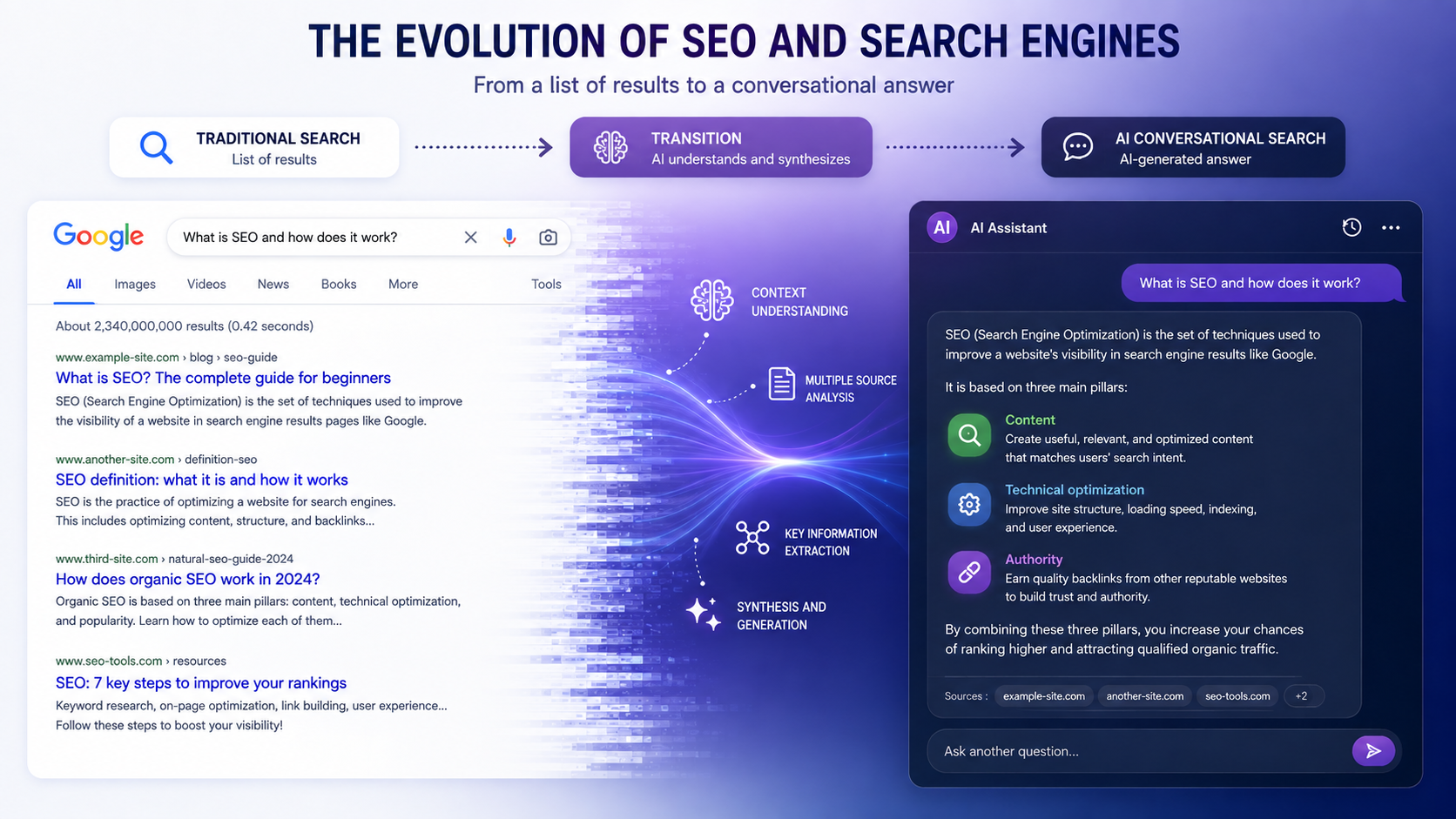
Today, a search engine can not only find pages that are likely to answer a question, but also analyze multiple sources, understand their content, and generate a summary answer on its own.
Google does this, for example, with AI Overviews and AI Mode. Microsoft also incorporates web content into the responses generated by Bing and Copilot. At the same time, conversational assistants and chatbots have created a new way to search for information.
The result: Ranking first on Google remains valuable, but a new question is emerging for brands:
How can you become a source that search engines and AI assistants understand, consider reliable, and choose to cite?
This is likely to be one of the key SEO challenges in the coming years.
How has SEO worked up until now?
To understand what's changing, we need to look back at how search engines have historically worked.
Broadly speaking, this process consists of three main steps.
1. Explore the Web
Search engine robots crawl websites by following their links. This process, known as crawl, helps discover new pages and detect changes made to existing pages.
Hence the historical importance of having a website that is technically accessible, fast, well-structured, and equipped with a coherent internal linking structure.
2. Understanding and Indexing Pages
Once a page is discovered, the search engine tries to understand its subject and may add it to its index.
Headings, text, links, images, structured data, and semantic context all contribute to this understanding.
This is where keywords have long played a central role.
In the early days of SEO, simply repeating a phrase enough times was sometimes enough to gain visibility. Search engines have gradually become much more sophisticated: rather than simply looking for an exact sequence of words, they now try to understand the intent behind a search.
3. Classify the results
When a user performs a search, the search engine selects the pages it deems most relevant and then ranks them according to numerous signals.
Among them:
- the relevance of the content;
- the quality and depth of the information;
- the authority of the site and its pages;
- links from other sites;
- user experience;
- technical performance;
- the freshness of the information when it is relevant;
- the reliability of the source.
Modern SEO was therefore already much more complex than "placing keywords on a page".
And contrary to popular belief, the arrival of AI does not render these fundamentals useless.
Google explains today that its generative search experiments rely in part on its traditional search, ranking, and quality systems. (Google for Developers)
What artificial intelligence is actually changing
The break occurs mainly after the search for information.
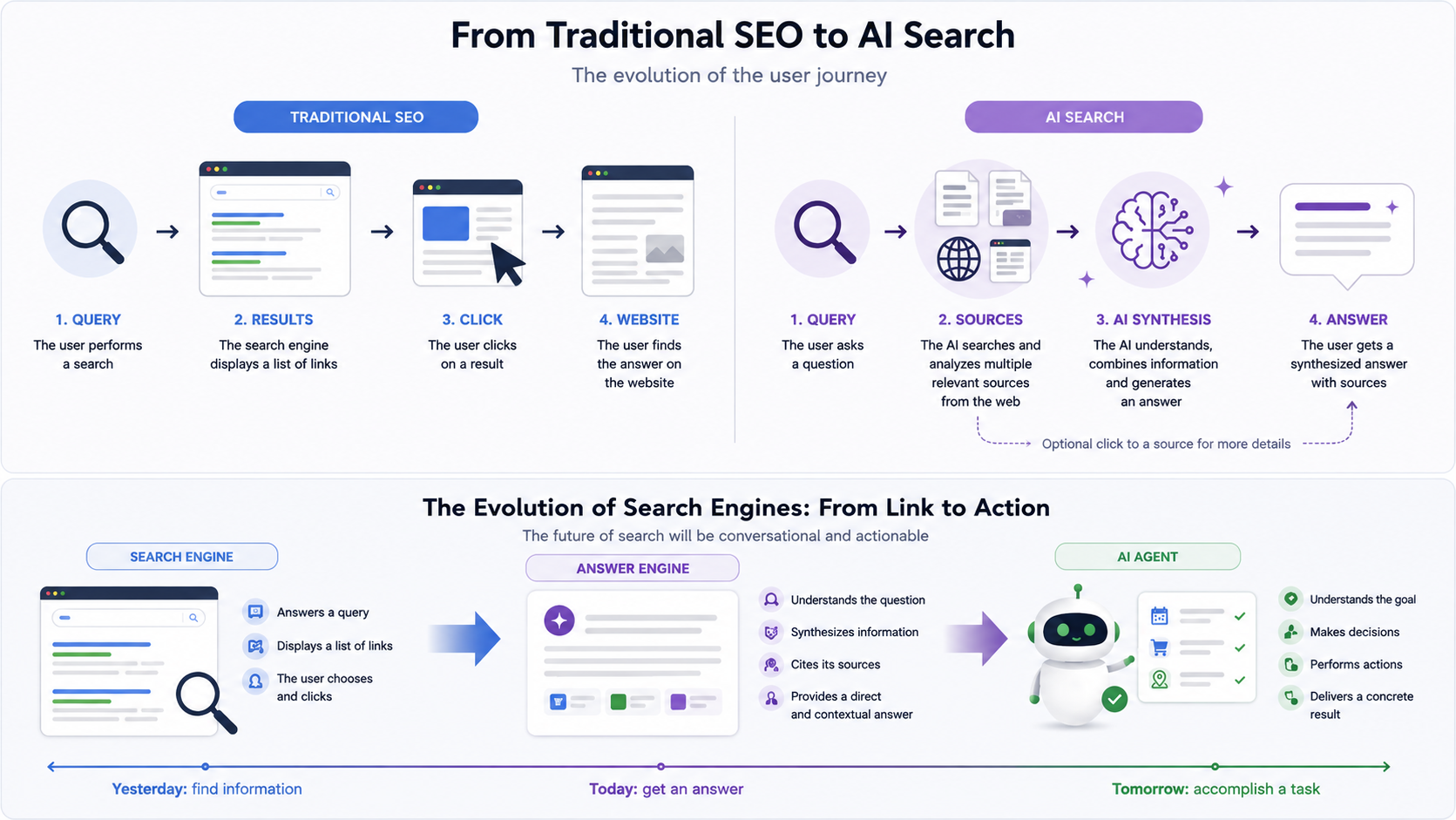
In a conventional search engine, the path looked like this:
Question → results list → click → website → answer
With a generative interface, it can now become:
Question → search for multiple sources → AI synthesis → answer → optionally click on a source
That small "possibly" represents a considerable change.
The goal is therefore no longer simply to gain a position in a list of links. It is also necessary to become a sufficiently relevant source to contribute to building an answer.
Google confirms that its generative features can use a RAG — Retrieval-Augmented Generation approach: the system retrieves information, notably from the search index, to anchor its responses in relevant and recent content. (Google for Developers)
In other words, the Web remains the raw material for part of generative research.
But the way this raw material is exploited is changing.
From SEO to GEO and AEO?
This evolution has given rise to several acronyms.
We speak in particular of AEO — Answer Engine Optimization, that is to say the optimization for answer engines, or of GEO — Generative Engine Optimization, to designate the optimization intended for engines using generative AI.
However, these labels should be taken with a grain of salt.
Google itself warns against certain misconceptions surrounding GEO and AEO, and reminds us in 2026 that existing SEO best practices continue to form the basis of visibility in its generative features. (Google for Developers)
Therefore, it is probably not a question of replacing SEO with a new discipline.
It would be more accurate to speak of a expansion of SEO.
We no longer optimize a page simply to ensure it is found and ranks well. We also aim to make its information:
easy to identify, easy to understand, easy to verify and credible enough to be reused or quoted.
7 new SEO priorities in the age of AI
1. Answer the questions clearly
Generative AI often seeks to construct a precise answer to a question.
Content that is unnecessarily long before reaching the essential information is therefore likely to be less effective.
A good practice is to organize certain sections according to a very simple logic:
question → short answer → explanation → proof or example.
For example :
Will AI replace SEO?
No. It primarily transforms how search engines use and present content. The fundamentals of SEO remain necessary to allow systems to discover, understand, and evaluate a page. The answer can then be elaborated upon.
This structure simultaneously benefits the internet user, the search engine, and the automated systems that analyze the content.
2. Focus on original information rather than volume
AI now makes it possible to produce hundreds of generic articles in a few hours.
It is precisely for this reason that generic content loses its relative value.
If ten thousand sites can publish virtually the same definition of a concept, why would a search engine have any interest in favoring yours?
Google explicitly recommends prioritizing original, useful, and user-centric content, regardless of how it is produced. (Google for Developers)
Content likely to gain value is therefore that which contains something difficult to reproduce automatically:
- an original study;
- proprietary data;
- field experience;
- a test;
- a methodology;
- a reasoned expert opinion;
- a comparison that was actually carried out;
- a client case;
- original photographs or videos;
- an analysis based on professional expertise.
AI makes content easy to produce. It therefore makes real-life experience rarer — and potentially more valuable.
3. Building genuine subject authority
Publishing a single article on a subject is not always enough to demonstrate expertise.
A more robust strategy is to build thematic clusters.
A cybersecurity company could, for example, create a central page on IT security linked to in-depth content on:
- phishing;
- ransomware;
- password security;
- multi-factor authentication;
- cloud security;
- data protection.
This architecture allows both readers and search engines to understand on which topics the site has real editorial depth.
Internal linking then becomes much more than a tool for transmitting authority between pages: it helps to create a coherent map of the site's expertise.
4. Strengthen trust signals
As the amount of content generated increases, the question "who is saying this?" becomes fundamental.
Google continues to emphasize the concepts of Experience, Expertise, Authoritativeness, and Trustworthiness (E-E-A-T), with particular emphasis on trust. (Google for Developers)
In practical terms, a website has an interest in making the following visible:
the author of the content, their skills, the sources used, the date of publication or update and, where relevant, the methodology used to obtain the information presented.
A solid "About" page, genuine author biographies, and verifiable references thus become important components of an editorial strategy.
5. Structuring information for humans… and machines
Readability is also becoming a factor in automated understanding.
A well-organized page makes it easier to identify the different pieces of information it contains.
Therefore, it is useful to use:
- a unique and descriptive H1;
- a logical H2/H3 hierarchy;
- relatively short paragraphs;
- tables for comparisons;
- lists when the information lends itself to it;
- genuinely useful FAQs;
- captions and alternative texts for the images;
- structured data is relevant when it actually corresponds to the content.
Google also recommends ensuring the accuracy and quality not only of the main content, but also of titles, meta descriptions, structured data, and image alt text. (Google for Developers)
The principle could be summarized as follows:
Information that is ambiguous for a human is also likely to be ambiguous for a machine.
6. Think in terms of entities rather than just keywords
Historical SEO reasoned heavily in terms of queries.
Modern SEO must also think in terms of entities and relationships between concepts.
Let's take a company specializing in heat pumps.
The goal shouldn't simply be to repeat "heat pump" in different articles. The site should build a coherent whole around the associated concepts: consumption, efficiency, COP, insulation, sizing, installation, maintenance, financial aid, types of housing, climate, etc.
We are therefore gradually moving from one logic to another:
"What keyword do we want to rank first for?"
to a logic:
"On what subject do we want to become a recognizable authority?"
This difference may seem subtle, but it profoundly changes the way an editorial strategy is built.
7. Measure visibility using methods other than clicks
This is probably one of the most important changes.
For a long time, SEO performance could be measured as follows:
print → position → click → session → conversion.
Generative responses introduce new scenarios.
A brand can be discovered or mentioned without immediately generating a click. A response can also influence a decision that will later materialize as a brand search, a direct visit, or a conversion on another channel.
The tools are also starting to evolve.
Since February 2026, Bing Webmaster Tools has offered a preview of metrics that allow publishers to see how their content is cited in certain Microsoft AI experiments, including Copilot and Bing's generative responses. (Bing Blogs)
Ultimately, SEO professionals will likely need to monitor the following simultaneously:
Positions + traffic + AI citations + brand visibility + conversions.
The click is not disappearing. But it could cease to be the sole unit of measurement for organic visibility.

Should we produce our content using AI?
This is obviously one of the major questions of the moment.
The short answer is: yes, but not just any way.
Google does not automatically penalize content simply because AI was involved in its creation. What matters most is its quality and usefulness.
However, using AI to massively generate pages without real added value may fall under Google's policies against content produced on a large scale with the aim of manipulating search results. (Google for Developers)
AI is therefore particularly interesting as a production tool, for example for:
research leads, organize ideas, build a plan, rephrase certain passages, synthesize documents or speed up certain repetitive tasks.
But ideally, the final value should come from what the company can add itself:
expertise + data + experience + opinion + human verification.
The goal is not to publish more because AI allows us to produce more.
It is about producing better thanks to the time it saves.
An AI-friendly SEO strategy for 2026
For a company wishing to adapt its SEO today, the strategy can be organized around five pillars.
1. Maintain a solid technical SEO foundation
Crawling, indexing, performance, architecture, internal linking, mobile compatibility, canonicals, sitemap and structured data remain essential.
An AI cannot easily exploit information that an engine cannot properly discover or understand.
2. Building areas of expertise
Rather than publishing on every topic likely to generate traffic, it is better to identify a few areas in which the company has genuine legitimacy.
Then treat them thoroughly.
3. Produce "quotable" content
Citable content contains information that is accurate enough to become a reference:
figures, definitions, methodologies, observations, comparisons, clear conclusions and verifiable sources.
4. Develop brand authority beyond the website
Press relations, mentions in specialized media, partnerships, professional communities, podcasts, studies and expert interventions all contribute to building a coherent digital presence.
The battle is therefore no longer solely about the authority of a URL, but also about the recognition of a brand or an expert as a legitimate source on a subject.
5. Optimize for conversion, not just for traffic
While some information searches are now resolved directly in an AI interface, the remaining traffic could become proportionally more intentional.
The pages must therefore clearly answer the following question:
What should the user do after obtaining the information they were looking for?
Register, request a quote, download a resource, test a tool, discover an offer or contact an expert: the answer should be obvious.

And tomorrow? Towards a web designed also for AI agents
This is where things get particularly interesting.
The next evolution could go beyond a simple engine capable of answering a question.
AI systems are gradually evolving towards agents capable of performing actions.
Google explicitly mentions AI agents as an emerging area in its new recommendations for website owners. (Google for Developers)
Let's imagine a search such as:
"Find me a hotel in Lyon for Friday night, near the train station, with parking, for less than 180$, then book it."
The search engine of the future could search for establishments, compare availabilities, analyze reviews, check constraints and carry out part of the transactional process.
In this context, SEO could gradually target three audiences:
the humans who read, the search engines that index, and the agents that act.
The quality of the data, its structure, its freshness and its technical accessibility could then become even more important.
SEO isn't disappearing: it's changing its focus.
Every major change by Google has led to the announcement of the death of SEO.
Social media was supposed to kill Google.
Voice search was supposed to kill text.
Featured snippets were supposed to kill clicks.
Now, AI is supposed to kill SEO.
The reality is more nuanced.
As long as people are seeking information and systems need to determine which sources to use to answer them, there will be some form of optimization of this visibility.
What changes is the objective.
Yesterday, the main thing was to be well ranked.
Today, you have to be found, understood, recognized and possibly quoted.
Tomorrow, it may also be necessary to be structured and reliable enough for an agent to be able to act on your data.
In this environment, the most sustainable strategies will probably not be those that seek to momentarily exploit the workings of an algorithm.
These will be the ones that accomplish something much more difficult to automate:
to become a true reference on their subject.
FAQ — SEO and Artificial Intelligence
Will AI replace SEO?
No. It changes how search engines find and present information, but content discovery, indexing, understanding, and evaluation remain essential. Google even states that SEO fundamentals remain applicable to its generative experiments. (Google for Developers)
What is GEO?
Generative Engine Optimization (GEO) generally refers to techniques aimed at improving the visibility of content in the responses generated by search engines and assistants using generative AI. It is more of an extension of SEO than a replacement for it.
Can ChatGPT or another AI be used to write SEO articles?
Yes. Using AI does not automatically result in a penalty. Google prioritizes the quality, originality, and usefulness of content, regardless of the production method. However, the mass generation of pages with no added value, with the aim of manipulating rankings, may violate its anti-spam rules. (Google for Developers)
How to appear in AI responses?
There is no guaranteed formula for getting a citation. A good foundation is to maintain solid technical SEO, produce original and verifiable information, clearly structure answers, develop topical authority, and keep important information up to date.
Are keywords still important?
Yes, but they should be considered as the expression of an intention and a subject rather than as strings of characters to be repeated. A modern strategy covers a coherent semantic universe and answers the various questions that the user asks.
Concluding remarks
Artificial intelligence doesn't spell the end of SEO; it profoundly transforms its rules. The fundamentals remain essential—content quality, relevance, authority, technical performance, and user experience—but they must now address a new challenge: being understood and recognized as a reliable source by search engines and AI assistants. The goal is no longer simply to achieve a high ranking in search results, but to produce information that is clear, original, and credible enough to be used in search engine results.
In the coming years, this trend is expected to accelerate further with the development of conversational engines and AI agents capable not only of searching for information but also of acting on it. The companies that will succeed will likely be those that invest in genuine expertise, original data, and structured, verifiable content. Tomorrow's SEO will be less about trying to understand the algorithm and more about becoming the source that the algorithm chooses.
Our Plugins
We have created powerful and widely acclaimed plugins for WooCommerce. Boost your sales with our solutions
WooRewards

Discover the most powerful loyalty plugin for WooCommerce. Simple or tiered systems, referrals, social networks, badges and achievements, you will find all the tools to build YOUR loyalty program
Learn MoreVIP Membership

VIP Memberships is a complete membership management tool for your WooCommerce site. Sell subscriptions to your customers and offer them benefits such as preferential prices or exclusive products.
Learn MoreVirtual Wallet

Offer your customers a virtual wallet on your website. Let them save money by purchasing your products and use this credit on future purchases. This extension also offers a complete gift card tool
Learn MoreReferral Codes

Win new customers with this complete SEO tool. Whether through influencers or simple referrers, reward them and the new customers they bring
Learn More
 EN
EN  FR
FR